Women's noble court in the Polish-Lithuanian Commonwealth in the Saxon times. Structure, people, culture, functions

About the project
Studies on women’s courts in the Saxon era open a completely new exploration path in Polish historiography, which in fact has been greatly popular in European science for many years. The fact of neglecting such an important research issue by Polish researchers creates a chance for undertaking thorough, in-depth and comprehensive studies on the structure, organization and functioning of nobles’ courts, especially female courts. The latter is a completely unknown issue, and yet women’s courts played a crucial role in the process of creation of politics, economy, cliental ties and cultural patronage.
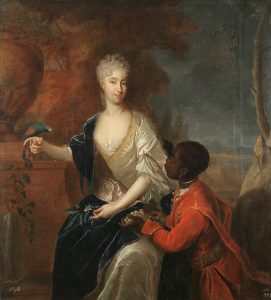
Tekla Roża z Radziwiłłów I voto Flemmingowa, II voto Wiśniowiecka, III voto Sapieżyna
The key component of the project will be to demonstrate the issues related to the establishment, structure and functioning of noblewomen’s courts and women’s activities not only within their patronage and their own interest groups, but also in educational and social spheres (e.g. social and literary salons or aristocratic courts). The analysis of a broadly understood court patronage and material culture is an important objective, closely connected with a subsequent determination of the standards of living at women’s courts in the Saxon era.
The originality and potential of the project are supported by the fact that in consequence, such broadly defined research objectives will allow us to take a holistic approach to the discussed subject and provide its thorough and exhaustive analysis. This will be achieved thanks to the extensive source material available in Polish and foreign archives, which has never been used by researchers. The studies will be of pioneering and innovative character, and the opportunity to take an innovative approach to the subject and present the specificity of diverse female activities, life at noblewomen’s courts, and the process of its evaluation will be possible not only thanks to traditional research methods but also interdisciplinary ones – comparative, sociological and anthropological, among others.